
The Perplexity vs Claude debate is one of the most common questions in AI communities right now — and it makes sense why. You have been using ChatGPT for a while. Then you heard about these two tools, and now you are wondering which one you actually need. Both are impressive. Both are free to try. And both can answer the same question in under ten seconds. So what is actually different?
Quite a lot, as it turns out.
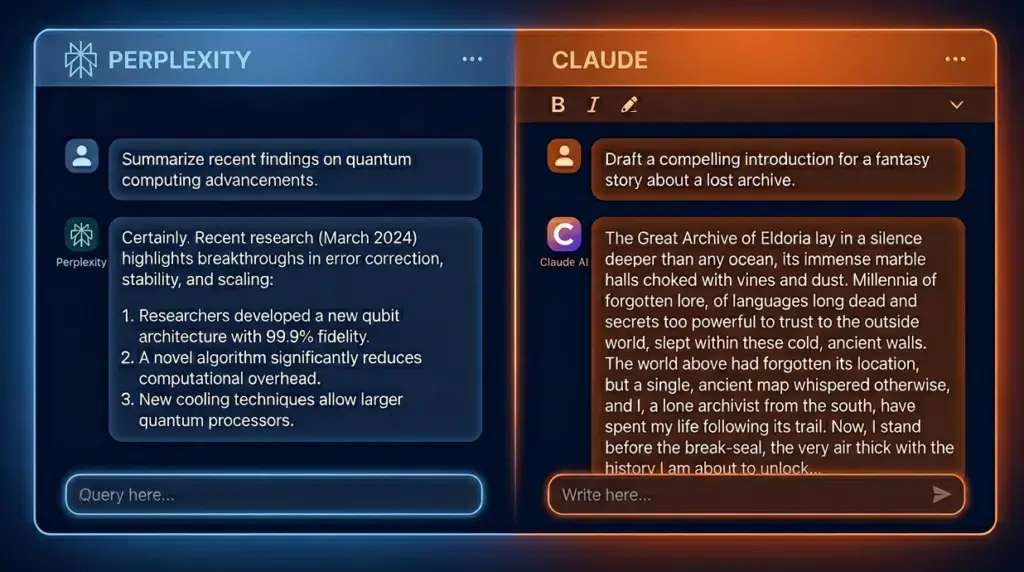
Even though they look similar on the surface, Perplexity and Claude were built to solve completely different problems. In fact, the Perplexity vs Claude question is really about two different philosophies. To put it simply, using the wrong one for the wrong job is like using Google Maps to write your cover letter. Both are useful. But neither is interchangeable.
I have spent time with both tools across real tasks — research, writing, coding questions, and long document analysis. This guide is what I wish I had read before I started. There is no affiliate spin here, and no vague winner announcements. Instead, you will get a clear, honest breakdown of what each tool is good at, where it falls short, and who should use what.
By the end, you will know exactly which tool fits your workflow — and whether it is worth paying for either one.
What Are Perplexity and Claude Actually For?
Before we get into any kind of comparison, it helps to understand the core idea behind each product. Because if you miss this part, every other comparison will feel arbitrary.
Perplexity AI — The AI-Powered Search Engine
Perplexity AI launched in 2022 with one clear mission: make search smarter. Not smarter in a vague way. Rather, smarter in the sense that instead of dropping ten blue links and leaving you to figure it out, it reads those sources for you. It then synthesizes the key information and hands you a structured answer with numbered citations you can click and verify.
Think of Perplexity as what Google Search would be if it actually answered your question. Instead, Google makes you scroll past three ads and a Reddit thread to find it.
By 2026, Perplexity has grown into a serious research platform. For example, the Pro plan now gives you access to Deep Research mode, which runs parallel searches across 20 to 30 sources at once. You also get file uploads, image generation, and the ability to switch between frontier models like GPT-5 and Claude Opus within the same interface. Additionally, there is Perplexity Computer — an agentic tool for complex, multi-step research tasks — and Focus Mode, which lets you target searches at academic papers, Reddit, YouTube, or the open web.
In short, what Perplexity has always been, and what it remains today, is a tool built around finding and verifying current information fast.
Claude — The AI Thinking Partner
Claude is built by Anthropic, a company founded by researchers who left OpenAI because they wanted to build AI more carefully. That background matters. It shapes everything about how Claude works — from how it handles ambiguous questions to how it pushes back when something does not make sense.
Unlike Perplexity, Claude does not search the web by default. However, that is not a limitation — it is a deliberate design choice. Claude is built specifically for reasoning, writing, and deep analysis. You give it a problem, a document, a codebase, or a half-formed idea, and it works through it with you. Its context window holds up to 200,000 tokens — roughly the length of a full novel. As a result, it does not lose track of earlier details in long, complex conversations the way smaller-context tools do.
In 2026, the flagship models are Claude Opus 4.7 and Claude Sonnet 4.6. Furthermore, Anthropic launched Claude Code — a terminal-based agentic assistant that can navigate entire codebases, make multi-file edits, and run tests autonomously. Developers have taken serious notice.
To summarize the difference simply: where Perplexity finds information, Claude thinks about it.
Perplexity vs Claude: Quick Overview (At a Glance)
Before diving into the details, here is a quick side-by-side overview of the two tools so you know what you are working with.
| Feature | Perplexity AI | Claude |
|---|---|---|
| Primary purpose | AI-powered search & research | Reasoning, writing & analysis |
| Real-time web access | ✅ Always on, with citations | ⚠️ Optional (paid plan) |
| Source citations | ✅ Every response | ❌ Not by default |
| Context window | ~32K tokens (standard) | Up to 200K tokens |
| Writing quality | Informational, structured | Natural, nuanced, voice-driven |
| Coding ability | Basic (Q&A, docs lookup) | Advanced (multi-file, agentic) |
| Image generation | ✅ (Pro plan) | ❌ Not available |
| Free plan | ✅ Generous free tier | ✅ Limited free tier |
| Paid plan price | $20/month (Pro) | $20/month (Pro) |
| Best for | Research, news, fact-checking | Writing, coding, deep analysis |
Perplexity vs Claude: Head-to-Head Feature Comparison
Now let us go through each major use case one by one. For each category, we will be honest about where each tool wins, where it loses, and where it is genuinely close.
1. Perplexity vs Claude: Real-Time Search and Current Information
Winner: Perplexity — and it is not close.
This is Perplexity’s home turf, and it dominates here. Every answer it generates is pulled from live web sources, cited with numbered footnotes, and linked back to the original pages. So if you ask about something that happened this morning — a policy change, a product launch, a market move — Perplexity will find it and show you exactly where the information came from.
Claude, without web search turned on, works from its training data. Therefore, for questions requiring up-to-the-minute accuracy, that is a meaningful limitation. Claude does offer optional web search in its paid plan, but search is bolted on — it is not what the product is built around. In contrast, Perplexity lives and breathes live information. The gap is real.
As a result, if your work requires staying current — in finance, law, journalism, technology, or academic research — Perplexity is not just better than Claude here. It is better than almost any other tool available.

2. Perplexity vs Claude: Writing Quality and Long-Form Content
Winner: Claude — by a clear margin.
Here is something worth saying plainly. If you have ever read AI-generated content and thought “I can tell a machine wrote this,” you have experienced what people call AI slop. The telltale openers. The hollow filler phrases. The way everything reads like a well-meaning student padding a word count.
Fortunately, Claude produces noticeably less of it. Multiple independent comparisons from 2026 describe Claude’s writing as having a “lived-in quality” — more direct, more natural, and more capable of sounding like a real person with a point of view. Moreover, one test that gets cited frequently involved giving both tools identical briefs with specific tone instructions. Claude tracked every constraint. Other tools drifted.
For content creators, bloggers, and marketers whose output will actually be read by humans, this difference matters a great deal. Perplexity can produce informational writing, but it reads like a research summary. It does not hold a reader’s attention the way Claude does.
3. Perplexity vs Claude: Research and Fact-Finding
Winner: Perplexity — for speed and source verification.
Perplexity’s Pro Search mode does something that feels almost unfair when you first use it. You ask a complex research question. It then runs parallel searches across 20 to 30 sources, reads them, and produces a cited answer in under two minutes. In other words, research that would normally take 30 to 45 minutes of tab-switching — done.
Additionally, the citation transparency is a genuine differentiator that gets underappreciated. In any professional context where you need to verify claims or attribute sources, Perplexity gives you that workflow built right in. Claude gives you comprehensive answers, but tracing exactly where a specific claim came from is harder.
That said, Perplexity finds the raw material. Claude knows what to do with it. Therefore, for synthesis, strategic analysis, or building an argument from your research, you will likely want to bring Claude in at that stage.
4. Perplexity vs Claude: Coding and Technical Work
Winner: Claude — especially for anything beyond basic questions.
Claude has quietly become the preferred AI tool among developers in 2026. Its flagship model scores 80.8% on SWE-bench Verified — a respected benchmark for software engineering tasks. It also achieves approximately 95% functional accuracy on coding tasks in independent testing. Furthermore, the 200,000-token context window means Claude can hold a large codebase in memory and reason across multiple files without losing its place.
Claude Code, launched in 2026, takes this even further. Specifically, it is a terminal-based agentic assistant that can navigate codebases, make multi-file edits, and run tests autonomously. Developers who have switched to it consistently describe it as the first AI coding tool that genuinely feels like a capable collaborator — rather than an autocomplete that sometimes gets lucky.
Perplexity is useful for looking up documentation or finding quick answers to language-specific questions. However, for actual software development work, there is no serious comparison.

5. Perplexity vs Claude: Reasoning and Complex Analysis
Winner: Claude — this is its strongest suit.
Claude scores 91.3% on GPQA Diamond, a benchmark that tests graduate-level science and reasoning at PhD difficulty. Notably, that is the widest margin Claude leads by in any major benchmark category compared to other tools in 2026.
In practice, this shows up most clearly with genuinely complex tasks. For instance, think of a business strategy with competing priorities, or a legal document with clauses that interact in non-obvious ways. Think of a financial analysis where variables keep changing, or a research synthesis where studies contradict each other. These are exactly the kinds of tasks where Perplexity hits a ceiling fairly quickly — and Claude keeps going.
One reviewer who spent 30 days tracking both tools put it plainly. He needed an average of 1.4 follow-up prompts with Claude to reach the same output quality that took 2.6 prompts with Perplexity. Per task, the difference seems small. However, across a full working month, it adds up to a significant amount of saved time.
6. Perplexity vs Claude: Conversation Quality and Context Memory
Winner: Claude — for anything beyond a single-question interaction.
Perplexity is excellent at answering individual questions. However, where it is weaker is in extended conversations where your fifth message builds on something you said in your first. It is a search-and-answer interface at heart, so each query tends to stand alone.
Claude, on the other hand, is built for conversation in a deeper sense. It maintains context across long interactions, picks up on nuance, and asks for clarification when needed rather than guessing. It is also honest about uncertainty in a way that builds trust over time. Consequently, users on major review platforms consistently rate Claude higher for natural conversation quality.
If you work through problems by talking them out — iterating on ideas, refining a draft, thinking out loud — Claude is clearly the more natural fit.
7. Perplexity vs Claude: Image Generation and Multimedia
Winner: Perplexity — by default.
As of mid-2026, Claude does not generate images, video, or audio. It is purely a text and code tool. Therefore, if you need visual content, you will need a separate tool like Midjourney, Adobe Firefly, or Microsoft Copilot Image Creator alongside it.
In contrast, Perplexity Pro includes image generation in the subscription. This makes it a slightly more versatile single-subscription option for users who occasionally need visuals alongside their research output.
Perplexity vs Claude: Pricing Comparison (2026)
Both tools follow a similar pricing structure — a free tier that is genuinely usable, and a $20/month paid plan that unlocks the full experience. Here is the detailed breakdown.
| Plan | Perplexity | Claude |
|---|---|---|
| Free | Unlimited basic searches, ~5 Pro searches/day, source citations included, no file uploads, no advanced models | Access to Claude Sonnet 4.6 with daily usage limits — good for occasional use |
| Pro — $20/month | Unlimited Pro searches, GPT-5 + Claude Opus + Gemini access, file uploads, Deep Research mode, image generation, Focus modes | 5× more usage, Claude Opus 4.7 access, Projects & Knowledge Bases, Claude Code included at no extra cost |
| Annual discount | $200/year (~$16.67/month, saves 17%) | Not publicly listed as of mid-2026 |
| Higher tiers | Max at $200/month (heavy research teams), Enterprise from $40/user/month | Max at $100–$200/month (high-volume use), Team plans available |
| Standout value | Multi-model access (GPT-5, Claude, Gemini) in one subscription | Claude Code included — huge value for developers |
One thing worth noting: Perplexity Pro lets you access Claude Opus as one of its models. So if you subscribe to Perplexity Pro, you already get some Claude capability bundled in. That said, it is a lighter integration. A dedicated Claude Pro subscription gives you the full context window and complete feature set.
Who Should Use Perplexity? (And Who Should Stick With Claude?)
When you break down the Perplexity vs Claude choice by user type, the answer becomes much clearer. Perplexity is the strongest fit for people whose work revolves around finding and verifying information. Specifically, it is the best choice for:
Students and researchers who need sourced, citable answers for papers or academic work. The citation format alone saves a lot of time.
Journalists, analysts, and fact-checkers who need to verify current information fast. They cannot afford to rely on outdated training data.
Professionals in fast-moving industries — finance, law, tech, healthcare — where information changes quickly. What was true six months ago may not be accurate today.
Anyone who wants a smarter search experience and is tired of scrolling past ads to find a straight answer.
Perplexity is also a smart complement to Claude. Many experienced AI users gather information in Perplexity, then bring it into Claude for writing and analysis. That combination is genuinely powerful.
Who Should Use Claude?
On the other side of the Perplexity vs Claude debate, Claude is the right pick if your work involves creating, reasoning, or building. It is the strongest choice for:
Content creators, bloggers, and copywriters who care about writing that does not sound robotic. Claude’s writing quality is the best available in 2026 for natural, voice-driven content.
Developers and software engineers who need a coding partner. Claude holds a full codebase in memory, reasons across multiple files, and handles complex refactoring without losing the thread.
Entrepreneurs, consultants, and business owners who need to think through strategy or analyze documents. Claude pushes back intelligently when something does not add up.
Anyone building an online business — whether you are writing product descriptions, building email sequences, or producing blog content. Claude delivers output closest to what a skilled human writer would produce.

Should You Use Both? The Honest Perplexity vs Claude Answer
Yes — and this is genuinely the smartest setup for most knowledge workers in 2026.
The workflow is simple and highly effective: search with Perplexity, think and write with Claude. First, use Perplexity to gather current, sourced information on your topic. Then bring that material into Claude to synthesize, analyze, draft, and produce your final output.
At $40 per month combined, you get two best-in-class tools covering the full range of knowledge work. In other words, you go from research all the way to finished draft without switching to a third tool. For anyone whose livelihood depends on good information and good writing, that is an extremely reasonable investment. In fact, most people who try both end up keeping both.
Perplexity vs Claude: Final Scorecard
| Category | Winner | Why |
|---|---|---|
| Real-time search | 🏆 Perplexity | Live web access with citations on every answer |
| Writing quality | 🏆 Claude | More natural, less robotic, follows complex briefs |
| Research depth | 🏆 Perplexity | Pro Search scans 20–30 sources in parallel |
| Coding & development | 🏆 Claude | 80.8% SWE-bench, 200K context, Claude Code |
| Complex reasoning | 🏆 Claude | 91.3% GPQA Diamond — widest benchmark lead |
| Long conversations | 🏆 Claude | Better context memory, more natural back-and-forth |
| Image generation | 🏆 Perplexity | Included in Pro plan; Claude has no image gen |
| Value for developers | 🏆 Claude | Claude Code alone justifies the Pro subscription |
| Value for researchers | 🏆 Perplexity | Best-in-class sourced research at $20/month |
| Overall versatility | 🏆 Claude | Broader capability range for everyday knowledge work |
Final Verdict: Perplexity vs Claude (2026)
So which tool wins the Perplexity vs Claude debate in 2026? If you are only going to pick one, pick Claude. Its capability range is wider and its writing quality is higher. Additionally, it handles the broadest range of everyday knowledge work tasks — from drafting content to debugging code to working through complex decisions. For most people, most of the time, Claude is the more useful daily driver.
That said, do not write off Perplexity. For research, fact-checking, and anything that requires current, sourced information, it does something no other tool does as well. Therefore, the ideal setup is using both — and the $40 per month combined cost is worth every dollar if AI tools are a meaningful part of how you work.
Ultimately, the only wrong answer is picking neither and sticking with a basic Google search for everything. In 2026, that is leaving a lot of capability on the table.
Frequently Asked Questions: Perplexity vs Claude (2026)
Is Perplexity better than Claude?
It depends entirely on what you are trying to do. Perplexity is better for real-time research and finding sourced, current information fast. Claude is better for writing, coding, deep reasoning, and long-form analysis. They are genuinely different tools built for different jobs — it is less a question of which is better and more a question of which is better for you.
Can I use Perplexity and Claude together?
Absolutely — and many experienced AI users do exactly that. The most effective workflow is to use Perplexity to gather and verify current information, then bring that material into Claude for synthesis, analysis, and writing. Search with Perplexity. Think and write with Claude. The two tools complement each other extremely well.
Is Claude free to use?
Yes. Claude has a free tier that gives you access to Claude Sonnet 4.6 with daily usage limits. It is a good way to get started and test the tool before committing to the $20/month Pro plan, which unlocks Claude Opus 4.7, significantly higher usage limits, Projects, and Claude Code.
Does Perplexity use Claude as one of its models?
Yes. Perplexity Pro subscribers can access Claude Opus as one of the available model choices within the Perplexity interface. This means at the $20 Pro tier, Perplexity gives you multi-model access — GPT-5, Claude Opus, and Gemini — all in one subscription. However, this is a lighter integration than a dedicated Claude Pro subscription, which gives you the full context window and feature set.
Which AI is better for content writing — Perplexity or Claude?
Claude, clearly. Writing quality is one of the areas where the difference between the two tools is most noticeable. Claude produces more natural, less robotic prose, follows complex tone and style instructions more precisely, and maintains voice consistency across long documents. If you are producing content that real people will read, Claude is the stronger tool.
Is Perplexity Pro worth $20 per month?
For frequent researchers, yes. The free plan limits you to around 5 Pro searches per day, which runs out quickly if you are doing serious research. Pro unlocks unlimited Pro searches, multi-model access, file uploads, and Deep Research mode — which alone can save hours of manual research time each week. If research is central to your work, $20/month is easy to justify.
Does Claude have real-time internet access?
Claude offers web search as an optional feature on its paid plan, but it is not the core of what Claude does. Unlike Perplexity, which is purpose-built around live web access and cites every source, Claude’s web search is a supplementary feature. For tasks requiring real-time, sourced information, Perplexity is the more reliable and more transparent choice.
Which tool is better for beginners who are new to AI?
Both are beginner-friendly, but Claude is probably the better starting point for most people. Its free tier is accessible, the interface is conversational, and it handles an extremely wide range of tasks — writing, answering questions, helping with code, analyzing documents, brainstorming ideas. Once you are comfortable with AI tools, adding Perplexity for research tasks makes a lot of sense.
Want more honest comparisons of the AI tools actually worth your time? Browse the AI Tools category on Verbionic — we cut through the hype so you do not have to.
Pingback: Claude AI Projects: Organize Work and Save Hours Every Week